It’s a good idea to begin with a loose permaculture plan for a desert property. This will be a starting point that you can edit many times as your land develops.
There is actually less to think about in an arid environment. It can be a blank canvas out there, but we can still find ways to waste time and be inefficient!
The big point of this lesson is to think of the desert property as a whole system. Its main parts will be earthworks for catching water, native trees and plants, veggies, food trees, mulch, buildings, rainfalls, animals, wind, shade and sun.
It all works together. We take steps to focus on and build up: holding and saving water, adding shade, adding mulch and increasing the biodiversity. Increasing the life in the soil and number of plants might be our ultimate focus.
If you stay consistent with learning a bit, then taking some action, day by day your site and knowledge will grow. Check out my list of resources (here) for wider learning about growing food in the desert.
Think about Your Goals
First off, what are your goals? Do you want to grow food for you and your family? Do you want to start a desert farm and sell food?
Do you want to start with a garden and see if you can grow into a farm later? Write out what you want to do. This can change over time too.
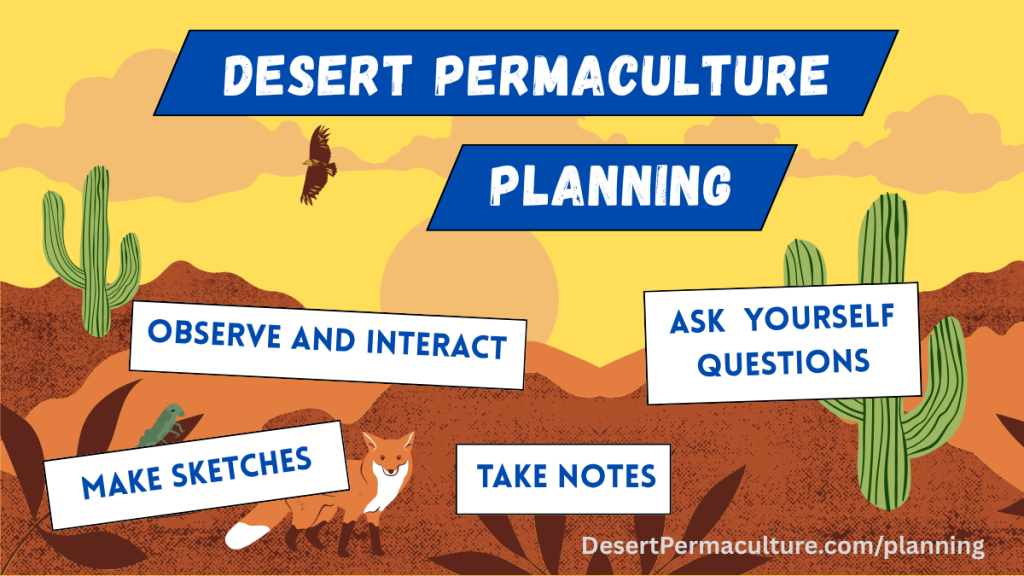
Walk the Property. Take Notes and Sketches
An initial survey will get some ideas flowing in your mind. Draw out your land and take lots of notes. Draw out what you would like to grow where.
Focus on the water flow of your land. Where do the gentle slopes come together and form small creeks? Where is the land compacted so that any water immediately runs off?
Use the following questions to get the big picture about your site.
Planning Phase Questions for you:
While you are walking and observing your property, take some notes answering these questions. They can guide your actions, vision and first steps.
- Is your ground compacted, have sand dunes, rocky or a mixture?
- What and where are the plants on your property?
- How often does it rain?
- Where does the water run during rain?
- Where are your creeks / runoff and where does the rain make puddles or pools?
- What are the low lying parts of your land?
- What path does the sun take over your land?
- What direction does the wind commonly blow?
- How do your buildings already give shade and a wind break?
- How can you catch water with your buildings?
- Where are the fences, roads and pathways?
- Are there dead plants and debris around that you can recycle in some way?
- What are the surrounding properties like?
- What animals are around your site?
Prioritize Your Projects
Now that you are getting to know your land, you can start planning what you want to do first. Quick wins can get you motivated and build your confidence.
A good first step might be to use any shade you have near your dwelling and start a garden patch. Mulch any dead material heavily around it to provide shade and cooling to the area.
Learn about gathering seeds from native plants. The trees, cacti and shrubs that are already growing will be a good starting basis for your work. Try not to destroy, but add!
Earthworks can be something that you slowly create every day. Or, you can plan out some work for a tractor or excavator if you have access to them. Before you hire or start this work, make sure to study exactly what type of earthworks you want to make.
Keep in mind what access you want to have to your earthworks. If you want to plant a row of trees, maybe a swale will be tough to access. A terrace with a path might be better.
If you just need an area to hold water, but you don’t need much access, then half moons staggered like fish scales or deep swales would work there. Maybe you are trying to hydrate a section of desert below.
Planning on Progression
The plants and trees already on your property are a valuable resource. They show us what is already working and provide anchors for wider plant growth. Use their shade and mulch to expand growing areas.
Small earthworks such as half moons near and above them can help hold further moisture. Gather seeds from the natives that are already growing there.
Look into nitrogen fixing legume trees. These are natural fertilizers for the surrounding soil and can rapidly improve food growing success near them.
So, try not to destroy but think of how you can build and grow upon what is already working. Learn and take action, then watch what happens and take more action!
Some things will die and fail. Keep asking why it failed so you can avoid it.