Why we Use Pioneer Trees and Plants for Desert Permaculture

Certain types of trees, shrubs and other plants can be planted to help support our food growing efforts in the desert. These pioneer plants have certain properties and strengths which make them useful to us.

Start a list with sections for supporting trees, shrubs and ground cover or flowers you want to try. When the plants check all the boxes in this post, your list might be surprisingly short when starting out.

Reasons to Plant Pioneer Species in the Desert

Pioneer species function to help our efforts when growing food in the desert. This is the “why” we need them:

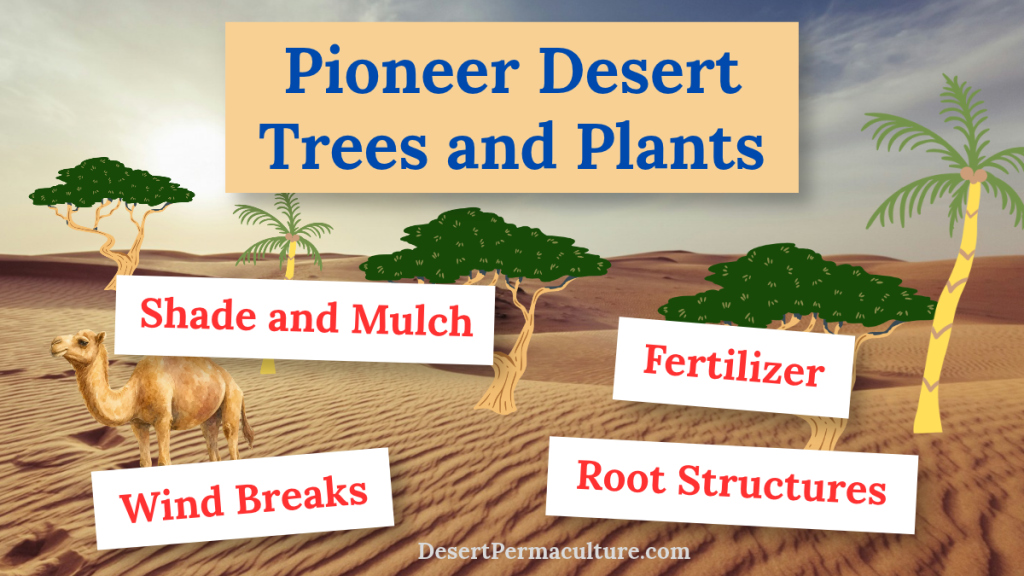
  • Shade is one of the biggest reasons to plant these supporting plants. We want to cool the ground, which limits evaporation and reduces the scorching of plants below them. Long term trees, perennial bushes and ground cover plants are options for this.
  • Mulch is also dropped or chopped from these supporting plants. This cools the ground further, promotes ground moisture and breaks down to feed and fertilize the soil. For more shade and mulch, the “bushier” the better! We benefit from more leaves and branches.
  • Wind breaks are needed to reduce evaporation further. The wind and heat work together to dry out land in the desert. So, we need to limit them both with these functional plants and trees.
  • They act as a barrier or fence. If you can’t fence your land from grazing animals, you may be able to get some dense areas of trees or plants to help you out over time.
  • Fire and cooking wood can also be provided for the cold desert months. That goal may be a few years down the road if you are starting out, though. It is still something we can think about, maybe choosing a tree species that keeps growing back after being heavily trimmed. Everything that gives us more self sufficiency is worth doing!
  • More root structures increase the life in the soil and hold dirt or sand in place.

Properties of Pioneer Desert Plants

There are some aspects we need for most of these pioneer plants. Keep these in mind when creating a list and choosing.

  • Heat Tolerant! We certainly want these trees and shrubs to be heat resistant desert plants first of all. That will eliminate many from our list.
  • Deep roots are needed to reach water sources. Often, we are planting them around earthworks (link) that we have created to hold water, which improves their survival rates.
  • Certain trees and shrubs are called “nitrogen fixers“. Their roots promote bacteria that create nitrates in the soil. In other words, they are natural fertilizers for the surrounding soil and plants. These can be somewhat rare, so first focus on shade and wind breaks.
  • Inexpensive plants are usually a goal for a desert budget. Trees in five gallon tubs cost less and actually adapt better. Five gallon pots are also very useful for us!

Choosing Supporting Desert Trees and Shrubs

There’s a few more things to consider when choosing pioneer species. First off, we need to find out what grows best in our local region! Start googling, searching Youtube and even asking some AI. You can consult local growers and experts too. Take note of the trees and bushes that are suggested by many sources.

In addition to heat tolerant, they should be perennial (keep growing back every year), so that we keep expanding the greenery year after year without them dying off. You can narrow down your list with nitrogen fixers and deep rooted plants. Also, seek out the fastest growing and “bushiest”.

We should be looking for seeds that are already around so we can buy less and start propagating quickly. A small (or large) greenhouse is helpful with that. Learning about saving and growing from seed is a valuable early step in any permaculture journey.

After all these considerations, we may have a small list and that is OK. We can start with multiple plantings of those few and see what works. In this way, we start to frame our land with plants that improve growing conditions.

We need to ponder water holding earthworks before we jump into planting. This gives our pioneer species the best chances of surviving the dry times. You can read about different earthworks here.

Pioneer Plant Conclusion

You can see there is a lot to consider! We want to plant things that will survive a long time and help us, so be selective about your list but also experiment. Here is a checklist of everything I covered:

Supporting Plant Checklist

Keep in mind each tree or plant doesn’t need to check every box. Experiment!

  • Grows well in your area
  • Is already growing near you (get seeds)
  • Heat and drought tolerant
  • Perennial (grows back every year)
  • Provides shade and a wind break
  • Drops mulch
  • Deep roots
  • Nitrogen fixer
  • Inexpensive

You might be constrained by money, so practice growing from seeds or transplanting baby trees and shrubs low in your water earthworks.

I have seen younger tree transplants work well since they can adapt to an environment better. They are also less expensive, which is great.

Multifunctional trees and plants are the best for our desert projects. Think of all the functions you get from a grove of bushy trees and shrubs that are giving us tons of mulch, shade and firewood while discouraging local, grazing animals from our gardens close to our homes.

Some food trees and plants even check all these boxes, so they will be a second layer of multifunctional helpers while also providing food. That’s what the next lesson is about. Good luck out there!
Pioneer Trees and Plants in Desert

Water Harvesting Earthworks in the Desert | Swales, Dams and More

After the planning stage, your garden and earthworks should be the first things to start building. There’s a lot of different ways to hydrate the land (soak it in), which is our goal.

Instead of rain running off our property, we want it to sink in and allow more growth in the area. We do this by building swales, terraces, half moons and dams (to name a few structures).

This post will show the many different types of desert earthworks along with their pros and cons.

Creek Check Dams

Many people are seeing success with small rock dams placed along desert creeks. When water flows, silt and debris fill in the dams and the water spreads widely. The speed of the water flow slows down as more dams are built one after another.

To make them, pile rocks along creeks where water flows and where you want it to slow down to soak in. Build them into the edge of the creek bed with a lower part in the middle for overflow. Place a layer of rocks where the water flow overfills so the dam doesn’t get undercut.

There are many other ways to create them using debris, construction material, stones, fencing, even old tires. Experiment with what you’ve got!

Water flows divert and the dams become like small terraces. You can even change the course of small creeks on purpose with check dams.

The downside is that they take time, resources and a lot of effort to build. But, if you dedicate to doing a couple a day, you will soon have dozens of experiments running. You will also get better at building them over time.

Swales (Long Trenches)

Swales are very popular in the permaculture world. They are dug trenches of various depths and widths. We put them “on contour” which means level in elevation. This is so water evenly collects in them. Here is a great discussion by Geoff Lawton about the sizing of swales:

There is usually a berm built up on the lower edge using the excavated dirt. This can be a great place for different types of trees, whether native, for mulch and nitrogen fixing, or food trees and plants.

In very harsh desert conditions, it makes sense to plant in the bottom of them where there is partial shade and more water collection with less evaporation.

Access to the trees and plants in swales needs to be planned with foot paths or roads nearby, unless you are using the swales to just to hydrate land in certain spots.

A downside is that if they fail along one part, they can lose most of their water since they are level.

Desert Ponds

Ponds can be a great feature in low lying areas to collect a large amount of water. Swales and creeks can be directed to them.

They should be lined somehow or packed with clay. Research them if they interest you! Plant various heights of plants around them to keep them shaded and reduce their evaporation.

Be mindful of where the water goes if it overflows during a storm. Will it go to another pond, swales or down a creek? Be careful about placing them near buildings.

Terraces

Terraces are flat, stair like structures. It makes sense to slightly angle them back towards the slope so water is held at each level. They can be easier to access the things you plant in them, but require lots of work or heavy equipment.

Half Moons (Bunds)

Half moons are like mini swales, but half circle pits. I saw one expert suggest that they should look like fish scales. This is so when one overflows, the one below it catches the water because they are off set on each level.

Each one should be planted with grasses, shrubs, or trees in the bottom of them. This is where the water collects and there is more shade.

They can be effective since it is no big deal if one of them fails. There are plenty more!

Zuni Bowls

These are small pond like structures that are lined with rocks. They are a lesser known structure, but worth a study. Moving a lot of rocks is a downside here.

You could build a couple of check dams with those rocks, but zuni bowls are something I wanted to share here.

So to conclude, ponder what earthworks make the most sense for your land and start experimenting! Consider the amount of work, your goals and the type of desert land your are working with.

Desert Permaculture Planning | Vision and Preparation

It’s a good idea to begin with a loose permaculture plan for a desert property. This will be a starting point that you can edit many times as your land develops.

There is actually less to think about in an arid environment. It can be a blank canvas out there, but we can still find ways to waste time and be inefficient!

The big point of this lesson is to think of the desert property as a whole system. Its main parts will be earthworks for catching water, native trees and plants, veggies, food trees, mulch, buildings, rainfalls, animals, wind, shade and sun.

It all works together. We take steps to focus on and build up: holding and saving water, adding shade, adding mulch and increasing the biodiversity. Increasing the life in the soil and number of plants might be our ultimate focus.

If you stay consistent with learning a bit, then taking some action, day by day your site and knowledge will grow. Check out my list of resources (here) for wider learning about growing food in the desert.

Think about Your Goals

First off, what are your goals? Do you want to grow food for you and your family? Do you want to start a desert farm and sell food?

Do you want to start with a garden and see if you can grow into a farm later? Write out what you want to do. This can change over time too.

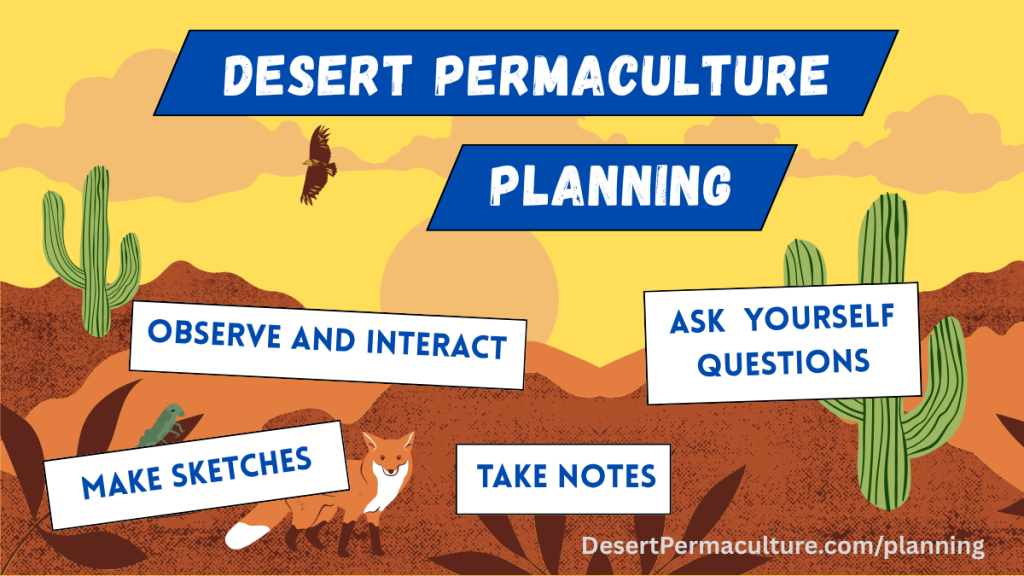
Walk the Property. Take Notes and Sketches

An initial survey will get some ideas flowing in your mind. Draw out your land and take lots of notes. Draw out what you would like to grow where.

Focus on the water flow of your land. Where do the gentle slopes come together and form small creeks? Where is the land compacted so that any water immediately runs off?

Use the following questions to get the big picture about your site.

Planning Phase Questions for you:

While you are walking and observing your property, take some notes answering these questions. They can guide your actions, vision and first steps.

  • Is your ground compacted, have sand dunes, rocky or a mixture?
  • What and where are the plants on your property?
  • How often does it rain?
  • Where does the water run during rain?
  • Where are your creeks / runoff and where does the rain make puddles or pools?
  • What are the low lying parts of your land?
  • What path does the sun take over your land?
  • What direction does the wind commonly blow?
  • How do your buildings already give shade and a wind break?
  • How can you catch water with your buildings?
  • Where are the fences, roads and pathways?
  • Are there dead plants and debris around that you can recycle in some way?
  • What are the surrounding properties like?
  • What animals are around your site?

Prioritize Your Projects

Now that you are getting to know your land, you can start planning what you want to do first. Quick wins can get you motivated and build your confidence.

A good first step might be to use any shade you have near your dwelling and start a garden patch. Mulch any dead material heavily around it to provide shade and cooling to the area.

Learn about gathering seeds from native plants. The trees, cacti and shrubs that are already growing will be a good starting basis for your work. Try not to destroy, but add!

Earthworks can be something that you slowly create every day. Or, you can plan out some work for a tractor or excavator if you have access to them. Before you hire or start this work, make sure to study exactly what type of earthworks you want to make.

Keep in mind what access you want to have to your earthworks. If you want to plant a row of trees, maybe a swale will be tough to access. A terrace with a path might be better.

If you just need an area to hold water, but you don’t need much access, then half moons staggered like fish scales or deep swales would work there. Maybe you are trying to hydrate a section of desert below.

Planning on Progression

The plants and trees already on your property are a valuable resource. They show us what is already working and provide anchors for wider plant growth. Use their shade and mulch to expand growing areas.

Small earthworks such as half moons near and above them can help hold further moisture. Gather seeds from the natives that are already growing there.

Look into nitrogen fixing legume trees. These are natural fertilizers for the surrounding soil and can rapidly improve food growing success near them.

So, try not to destroy but think of how you can build and grow upon what is already working. Learn and take action, then watch what happens and take more action!

Some things will die and fail. Keep asking why it failed so you can avoid it.

Desert Permaculture Planning Graphic - Ask Questions, Sketch, Take Notes

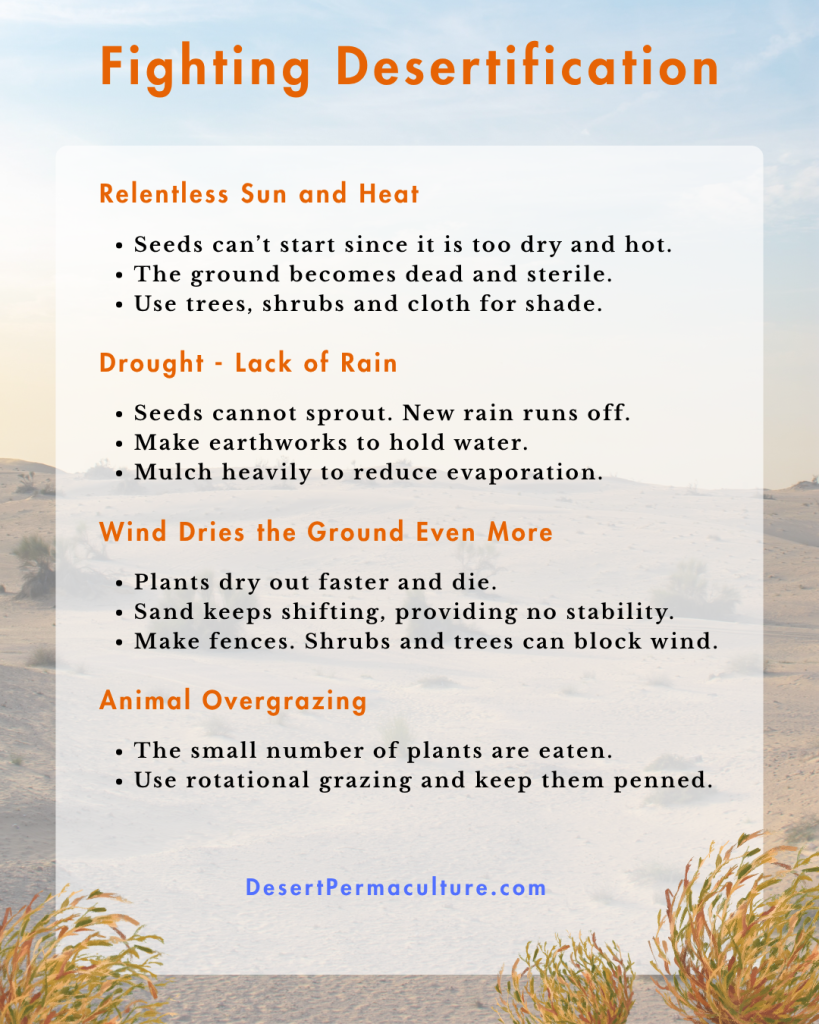
How Desertification Happens and how it is Being Reversed

It’s important to think about how desert becomes desert when we are trying to grow food in them. What are the factors that make arid lands so dead and what are people doing to combat it? There are thousands of projects all over the world we can study for ideas.

The most destructive quality of a dead desert is that its dirt has very little life in it. When practicing permaculture, farming and gardening in the desert, we take steps to boost life and biodiversity in the ground. This life holds water and transforms nutrients into plant food.

Lack of Rain and Water Soaking

Plants need water of course. Deserts form where water is scarce. When there is rain it mostly runs downstream without staying in the land. This is from compacted, dead dirt or constantly shifting dunes.

Seedlings can’t make it. There is no root structure and the soil stays lifeless. Microbes in the ground are the main holders of water. Without them, the ground quickly drains water.

Solution: There are different types of earthworks we create to hold the water that does fall. When water flow is stopped, it soaks into the land and soil life grows.

Swales are long ditches that can do this. Smaller pits and half moons can be dug to make small climates in each one too. In desert streams, we create small dams (usually with rocks) that slow the flow and spreads the creek out.

Storing water coming off buildings is vital too. It should be redirected to storage tanks, reducing the reliance on your well.

The Scorching Sun and Heat!

Plant starts can’t survive the desert sun and hot months when there is no shade around.

Solution: Creating shade is one of the main goals of our efforts. Hearty trees that are native, nitrogen fixing and grow well in your area should be considered first.

We plant layers of plants to keep the ground cool with shade. From ground cover to bushes and trees of different sizes, we put in what does well in the area. The shade and cooling prevents evaporation.

Heavy mulching from the many plants is another part of combating the sun. The few inches of plant material we keep on the ground brings the temp down. The mulch breaks down and feeds the life in the soil for an added benefit.

It’s vital to take these actions which have many functions when battling an arid desert. The many layers of plants do this naturally as long as we also fight the…

Drying Wind

Desert wind is another thing that dries out the area, leading to desertification. Wind along with heat adds to evaporation of any moisture that collects from rain or dew in the morning hours.

Solution: Windbreaks that are natural or ones that we make should be planned out. They can be made from trees, shrubs, debris, fences or deep swales, whatever is handy that can block the wind.

We need to keep observing our land and note where the wind mostly comes from. Any buildings should be considered a windbreak and used to the fullest for a small, close in (permaculture zone 1) garden.

Overgrazing of Animals.

Animals such as cows, goats and sheep that are allowed to freely range will eat all the plants in an already barren landscape.

Solution: This problem can be the most difficult to solve, requiring fencing or dogs to keep grazing animals away.

People that practice regenerative agriculture have found benefits to rotational grazing, though that applies more to grasslands.

Keeping animals penned up requires more feed. Limiting your number of animals seems to make the most sense when starting a desert garden or farm.

To summarize: heat, drought, wind and animals create a negative feedback loop that kills all life in the soil. To reduce and reverse these processes, we create earthworks to hold water and windbreaks to lower evaporation.

Then we plant hearty, native pioneer shrubs and trees. We mix in food trees, food shrubs and place gardens in the most protected areas.

The root structures, heavy mulching and layers of shade create positive, life expanding processes.