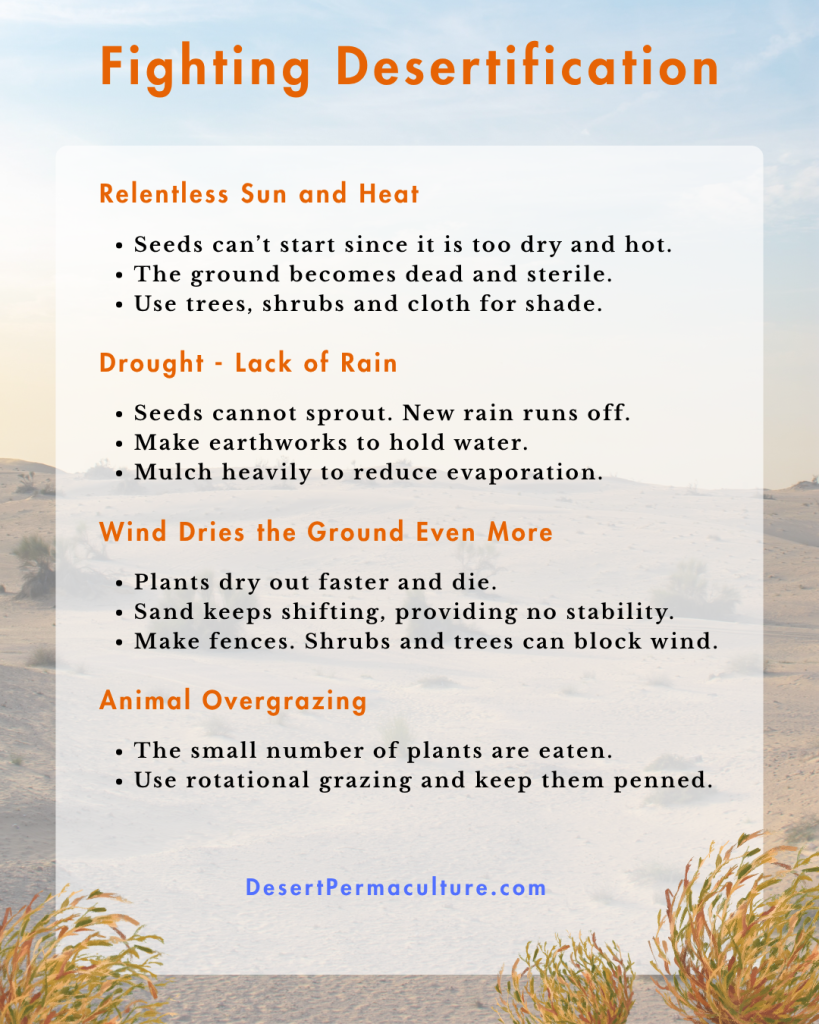
It’s important to think about how desert becomes desert when we are trying to grow food in them. What are the factors that make arid lands so dead and what are people doing to combat it? There are thousands of projects all over the world we can study for ideas.
The most destructive quality of a dead desert is that its dirt has very little life in it. When practicing permaculture, farming and gardening in the desert, we take steps to boost life and biodiversity in the ground. This life holds water and transforms nutrients into plant food.
Lack of Rain and Water Soaking
Plants need water of course. Deserts form where water is scarce. When there is rain it mostly runs downstream without staying in the land. This is from compacted, dead dirt or constantly shifting dunes.
Seedlings can’t make it. There is no root structure and the soil stays lifeless. Microbes in the ground are the main holders of water. Without them, the ground quickly drains water.
Solution: There are different types of earthworks we create to hold the water that does fall. When water flow is stopped, it soaks into the land and soil life grows.
Swales are long ditches that can do this. Smaller pits and half moons can be dug to make small climates in each one too. In desert streams, we create small dams (usually with rocks) that slow the flow and spreads the creek out.
Storing water coming off buildings is vital too. It should be redirected to storage tanks, reducing the reliance on your well.
The Scorching Sun and Heat!
Plant starts can’t survive the desert sun and hot months when there is no shade around.
Solution: Creating shade is one of the main goals of our efforts. Hearty trees that are native, nitrogen fixing and grow well in your area should be considered first.
We plant layers of plants to keep the ground cool with shade. From ground cover to bushes and trees of different sizes, we put in what does well in the area. The shade and cooling prevents evaporation.
Heavy mulching from the many plants is another part of combating the sun. The few inches of plant material we keep on the ground brings the temp down. The mulch breaks down and feeds the life in the soil for an added benefit.
It’s vital to take these actions which have many functions when battling an arid desert. The many layers of plants do this naturally as long as we also fight the…
Drying Wind
Desert wind is another thing that dries out the area, leading to desertification. Wind along with heat adds to evaporation of any moisture that collects from rain or dew in the morning hours.
Solution: Windbreaks that are natural or ones that we make should be planned out. They can be made from trees, shrubs, debris, fences or deep swales, whatever is handy that can block the wind.
We need to keep observing our land and note where the wind mostly comes from. Any buildings should be considered a windbreak and used to the fullest for a small, close in (permaculture zone 1) garden.
Overgrazing of Animals.
Animals such as cows, goats and sheep that are allowed to freely range will eat all the plants in an already barren landscape.
Solution: This problem can be the most difficult to solve, requiring fencing or dogs to keep grazing animals away.
People that practice regenerative agriculture have found benefits to rotational grazing, though that applies more to grasslands.
Keeping animals penned up requires more feed. Limiting your number of animals seems to make the most sense when starting a desert garden or farm.
To summarize: heat, drought, wind and animals create a negative feedback loop that kills all life in the soil. To reduce and reverse these processes, we create earthworks to hold water and windbreaks to lower evaporation.
Then we plant hearty, native pioneer shrubs and trees. We mix in food trees, food shrubs and place gardens in the most protected areas.
The root structures, heavy mulching and layers of shade create positive, life expanding processes.